

How old is your sidewalk? The lichens know!
BLWGLichens are a remarkable partnership between a fungus and an alga. Together they form a symbiosis that allows them to survive in places where few other organisms can. Sidewalks are one such harsh environment: they become hot and dry in summer, are walked on every day, and provide very little water or nutrients. Although lichens are well adapted to these conditions, they grow extremely slowly.
From glacier valleys...
The science of estimating the age of rock surfaces from the size of lichens is known as lichenometry. Traditionally, this technique has been used over timescales of hundreds of years to determine when rocks were exposed after glaciers retreated or cliffs collapsed. In cold mountain regions, lichens may grow by as little as 0.1 millimetres per year, allowing individual lichens to live for centuries. For the first time, researchers have now applied lichenometry systematically in an urban environment.

...to the city
The most common paving stone in Dutch residential neighbourhoods is a grey concrete slab measuring 30 by 30 centimetres. By far the most abundant lichen growing on these slabs is Circinaria contorta. To determine its growth rate, students from Yuverta and Wageningen University measured 9,000 individual lichens. They recorded the ten largest lichens on each of 900 sidewalks ranging in age from 1 to 30 years. Thanks to openly available municipal records from the cities of Arnhem, Nijmegen and Woerden, the researchers knew exactly when each sidewalk had been installed or replaced. After about 30 years, sidewalks are often renewed, making older surfaces unsuitable for this method.
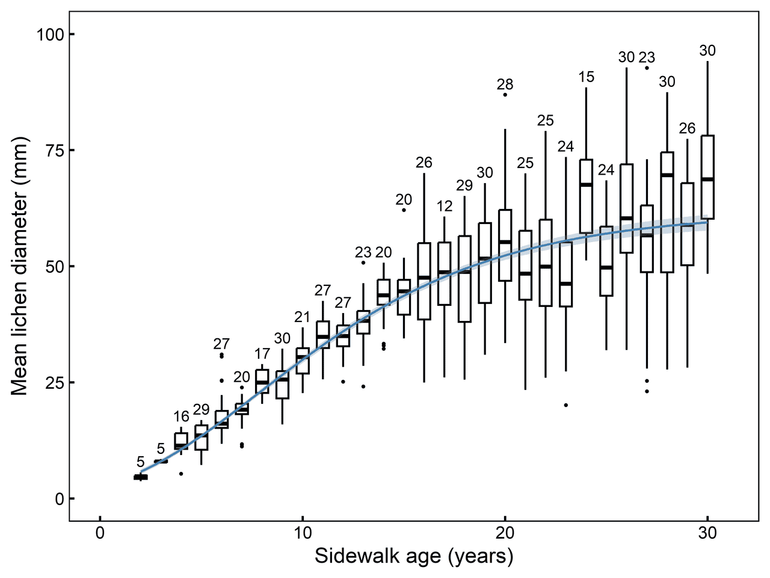
The measurements showed that Circinaria contorta grows by an average of 2.3 millimetres in diameter each year, with a maximum growth rate of 3.3 millimetres per year. The first tiny lichens appear one year after a new sidewalk is laid. Over the next three decades they gradually develop into grey circles about 7 centimetres across. Surprisingly, the growth rate was almost identical in all three cities. Factors such as shade and the presence of weeds had little effect.
Measure your own sidewalk
Now that we know how quickly these lichens grow, anyone can estimate the age of a sidewalk. Take a ruler and measure the diameter of the ten largest Circinaria contorta lichens you can find. Divide the average diameter by 2.3 millimetres, and you'll have a good estimate of how many years have passed since the sidewalk was laid. With the graph below, you can make an even more precise estimation. An accompanying calibration graph from the study allows even more accurate estimates.
Measuring lichens is an easy activity that can be carried out almost anywhere, making it ideal for biology classes, citizen science projects and guided nature walks.
More information
- Following Open Science principles, both the scientific paper and the underlying data are freely available:
- Urban lichenometry: growth of Circinaria contorta on city sidewalks.
- The complete dataset and analysis scripts are available via Zenodo. All measurements of Circinaria contorta have also been incorporated into the Dutch National Database of Flora and Fauna (NDFF) and the Global Biodiversity Information Facility (GBIF).
Text: Laurens Sparrius, Bryological and Lichenological Working Group (BLWG) and Gideon Engelberts
Images: Fleur Dalhuisen; Laurens Sparrius; Gideon Engelberts