

Bewick’s swans are migrating shorter distances: younger birds appear to be behind the shift
Institute for Biodiversity and Ecosystem Dynamics (IBED)In his PhD research, Hans Linssen of the University of Amsterdam (UvA) and the Netherlands Institute of Ecology (NIOO-KNAW) shows that this adaptation is the result of two processes. First, the birds are responding to the temperature: when it is warm in the fall, they do not migrate as far. Second, young birds are less likely than their parents to return to where they spent a previous winter, instead remaining further northeast.
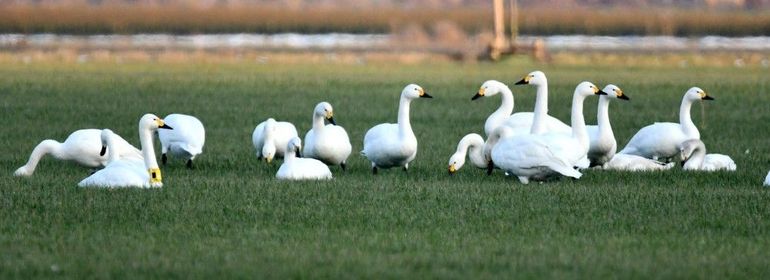
Many Bewick’s swans are fitted with colour rings, which can be read by volunteers. From these ring reports, it might seem like the Bewick’s swans are very sedentary. For example, the Bewick’s swan 280E was reported to be in the Vughtse Gement for the tenth consecutive winter. This raises the question of how the population can expand. The current theory is that young birds visit new areas, which they return to annually. But how does this work for birds that travel in families, such as geese and swans?
Method
Linssen along with other scientists from UvA’s Institute for Biodiversity and Ecosystem Dynamics (IBED) tracked about 120 Bewick’s swans with GPS transmitters, which yielded millions of location data points over several years. The data allowed them to examine the mechanisms behind the population shift. They observed that the swans consistently adjusted their behaviour based on temperature. During mild winters, they often stay hundreds of kilometres further to the northeast. Cold spells drive them towards the Netherlands, France, or the United Kingdom. Individual swans continue to adapt their migration routes and wintering grounds to changing conditions throughout their lives. Since these birds can live long, over the years, they tend to winter further and further to the northeast.
Flying with parents
The researchers also tracked entire swan families. Young swans stayed with their parents for almost a year. This is crucial, as young swans that lose their parents at a young age are less likely to survive. Parents help their children with navigation (where to fly), timing (when to leave), conserving energy (flying in formation), and finding food. Only 38 percent of the parentless young birds survived their first year, compared to 83 percent of young birds who stayed with their parents. Orphaned Bewick’s swans were also unable to join other families, suggesting that families foster strong learning processes.
Decline in the Netherlands
Throughout their life, Bewick’s swans regularly return to where they spent the previous winter. At the same time, younger generations vary much more in their wintering grounds than older swans, who stick more firmly to their established routines. In this way, young birds combine what they learned from their parents during their first winter with exploring new areas.
It is these younger generations that are driving the shift of the wintering grounds to the northeast. The Netherlands, once a key winter destination for Bewick’s swans, is visited much less frequently because of the milder winters. Birds are more likely to remain in Germany or Denmark.
Despite the birds’ adaptability, the Bewick’s swan population has been declining for years. That does not seem to be because of winter changes, which the swans are well-adapted to, but rather to breeding success. Yearly, only 30 percent of adults attempt to breed, which could explain the declining population. There is no evidence that the swans are suffering from breeding ground warming, so it is unknown why few birds are breeding.
About the Bewick’s swan
The Bewick’s swan is the smallest of the three species found in the Netherlands and Belgium. Bewick’s swans breed on the northwest coast of Russia and spend the winter in northwestern Europe. They used to spend their winters in England and the Netherlands, but now they shift to Northwest Germany. For migrating birds, such as the Bewick’s swan, timing is crucial: if they arrive at the breeding site too late, they miss the peak food availability and their breeding success declines.
Text: Institute voor Biodiversity and Ecosystem Dynamics (IBED)
Images: Hans-Joachim Augst; Rolf Veenhuizen