

Count the flowers and know a grassland’s biodiversity
Dutch Butterfly Conservation, Wageningen University & ResearchIn some meadows, the sheer diversity of flowers in spring and summer is striking. Naturalists know that such meadows are alive with numerous kinds of insects. But can the flowers reliably indicate how many plant and arthropod species occur in a grassland, and serve as a practical tool for large-scale biodiversity surveys? That is exactly the question that researchers from Wageningen University & Research set out to answer. Their encouraging results are now published in the journal Ecological Indicators.
The problem with measuring biodiversity
“Biodiversity monitoring is very laborious, especially when it comes to insects and other invertebrates” says Reinier de Vries, lead author of the study. “There are vast numbers of species and for many, specialist knowledge is needed to find and identify them. Many species are only active during short time periods. This makes it practically impossible to keep track of all insect populations across our landscapes.” Therefore, most biodiversity surveys focus on small areas or on single species groups — often rather well-known groups, such as butterflies or ground beetles – that are seen as proxies for the wider community of species. Unfortunately, many studies have shown that the diversity of these single groups does not necessarily indicate arthropod diversity as a whole. The richness of plant species does not always reflect arthropod biodiversity either, and plant monitoring still depends on time-consuming specialist work.
Ecologists have been searching for indicators that are representative of wider biodiversity patterns, but also fast to measure and easy to interpret. Such indicators can reveal the quality of certain habitats for biodiversity. In grassland habitats, flowers appear to fit the bill.
Counting insects and flowers
The researchers visited 41 grasslands in the southernmost part of the Netherlands: a small-scale, hilly landscape that is one of the country's biodiversity hotspots. De Vries says: “These grasslands spanned the full spectrum of land use intensity, from heavily fertilized agricultural grasslands to extensively managed, semi-natural grasslands with a high diversity of flowering plants.” Grasslands cover 20 percent of the Dutch land surface but, largely due to the increasing intensity of agricultural land use, biodiversity-rich grasslands have become very rare over the last decades.
The research team set out a 150 by 1 meter transect in each grassland. All the flowers within this transect were counted and identified, and arthropods were surveyed along the transect using sweep nets and pollinator counts. These surveys were repeated in April, June and July. “We recorded 520 different arthropod species in total, including wild bees, true bugs, spiders, ants, grasshoppers and several families of flies and beetles”, says De Vries. “We investigated if the species richness of these groups can be explained by the species richness or the total cover of open flowers in the grassland.”

The richness of flower species is what matters
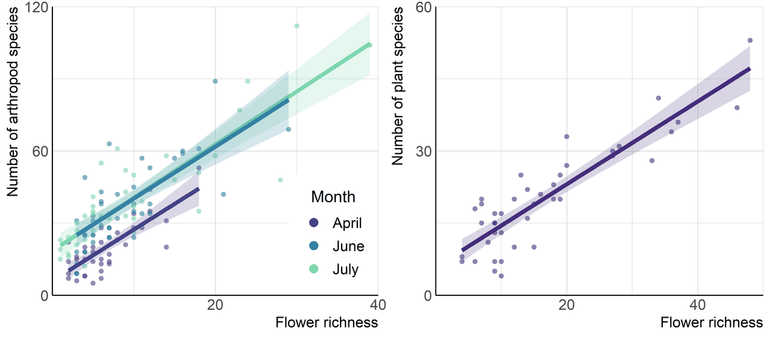
The richness of flower species (flower richness) in a transect predicted the numbers of species of plants and six out of seven arthropod groups. De Vries: “It is likely that these relations reflect different ecological connections. The relation with plant richness is unsurprising, and we also know that pollinating insects, such as wild bees, respond strongly to flower richness. But we also found positive relations with spiders and grasshoppers, which are not directly dependent on flowers. A high flower richness probably indicates suitable habitat conditions for these arthropods. Think of more open and structurally complex vegetations with limited disturbance, where many different species can find food and shelter.”
Flower cover was a much poorer biodiversity indicator. A few species dominated the total flower cover, such as dandelions and white clover. When these species flower en masse, fields can look flower-rich, while actually being poor in biodiversity. What matters is not how many flowers are present, but how many different kinds.
Broad representativeness
Arthropod biodiversity builds up during spring and early summer, but the connections with flower richness remained consistent. As a result, flowers can reveal if a grassland becomes more or less suitable for biodiversity during the growing season. Many intensively managed grasslands largely lost their flowers already in May, but the variety of flowers and arthropods in semi-natural grasslands only increased. These grasslands thus become more and more important biodiversity refuges during the growing season.
The relations with flower richness were consistent across different land use intensities. This means that flower richness can be used as a general biodiversity indicator, regardless of whether you are assessing an intensively grazed pasture or a botanically rich nature reserve. This is important for monitoring and policy purposes.
Practical implications: from field surveys to farm payments
Powerful biodiversity indicators should not only be broadly representative, but should also be simple to assess and interpret objectively. The flower richness of grasslands is an intuitive proxy that is easily visible to both nature managers, farmers and citizens. Flowers can be identified with identification apps, and potentially even by automated remote sensing tools. This way, flower surveys could potentially be carried out across entire landscapes in the future. “We currently have no biodiversity data at this scale” says De Vries, “because it is impossible to monitor every field. Even most programs for nature restoration or nature-friendly farming know little about their effects on arthropods. Rapidly measurable indicators, such as flower richness, can be used to evaluate the success of these schemes”.
Moreover, the flower richness of a grassland is directly related to its management. “Farmers can improve the flower richness of their fields through tailored management”, says De Vries. “When we would use flower richness to evaluate the results of nature-friendly farming schemes, we can also use it as a basis to reward farmers for the achieved results. Financial rewards for farmers are necessary, because to restore flowers and biodiversity, farmers need to work more extensively. This reduces their income from production, while society benefits. Rewards for biodiversity recovery can address this and provide alternative means of income”.
Not a replacement of arthropod monitoring
Flower richness provides an efficient, scalable way to assess the general biodiversity value of grasslands, but it does not tell which species are present, or how their populations are faring. Detailed species inventories and analyses remain essential to answer these questions. Complementing more general indicators, such as flower richness, such inventories can focus on the most valuable habitats.
More information
- This article is based on the article Flower species richness is an effective indicator of aboveground grassland arthropod biodiversity, published in May 2026 in the scientific journal Ecological Indicators.
Text: Reinier de Vries, Wageningen University & Research
Images: Reinier de Vries (lead photo: hills covered with grassland in the south of The Netherlands); De Vries and colleagues