With the current rising sea levels, this news sounds hopeful for the future of these coral reefs. Still, Mike advocates cautious optimism: “There is definitely hope, but we do not want to stop trying to improve things, right?”, says Mike.


What the past of coral reefs can tell us about their future
Naturalis Biodiversity Center
13-JUN-2026 - Coral reefs are important ecosystems. They have encountered a lot of hardships across their existence on Earth and are facing significant threats again today. Mike Hynes discovered that the past of coral reefs can tell us a lot about their own future.
On Wednesday May 20th, 2026, Mike Hynes defended his thesis, titled Coral Reef Time Machine: Holocene reef geomorphology and paleoecology of the Spermonde Archipelago. His research shows that, through paleoanalysis of the reefs of the past, we can understand how current reefs could react in response to the current rise of the sea level.

Going all around the globe
After finishing his bachelors in Geology in Canada, Mike took a gap year and went to Australia. It was there that he discovered an interest in coral reef ecosystems: “They have been around so long, and they have seen so much. If we could get them to talk, they could tell us a lot about what happened”.
Moving on to England to do his masters, Mike decided that, for his next project, he would see if there would be a way he could combine paleontology with the coral reefs that he recently discovered his love for. This brought him to Naturalis, the University of Amsterdam, and the 4D-REEF program for his PhD.
Corals and their trials
The Coral Triangle is an area on the threshold between the Indian and the Pacific Ocean where the density and diversity of coral species is highest on Earth. It is therefore an important region that has been highly researched. However, there is still a gap in knowledge about the far past of these ecosystems today. Understanding this past is essential, as this area is not exempt from global environmental pressures. For example, changes in sea level directly influence the coral's growth rates. Through Mike’s research, he aimed to see how specific reefs from the shelf of the Spermonde Archipelago in Indonesia were growing over 7000 years.
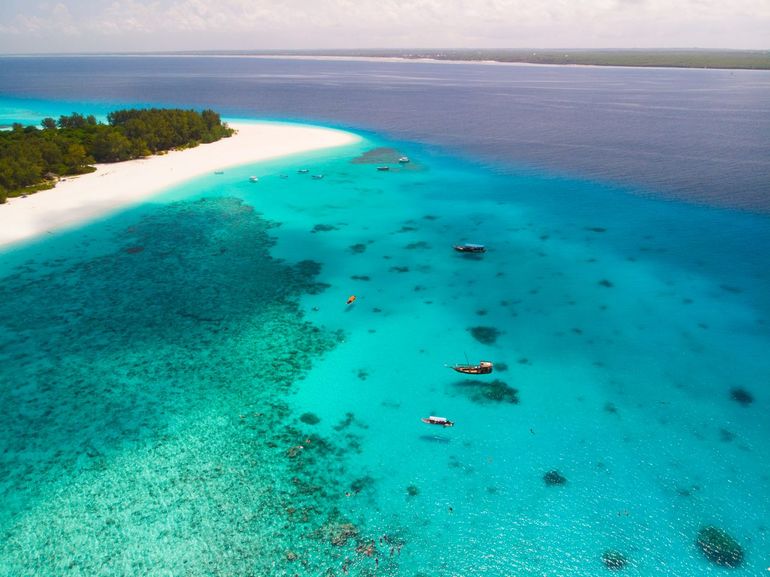
These islands built by reefs represent important livelihoods, fishing grounds, a source of (eco)tourism and food for many locals. “We are talking of literally millions of people who depend on these reefs". It is thus important to research these reefs and their past, for the future of both the ocean’s biodiversity and the people that depend on it.
The past revealed
“We took aluminium tubes, six meters long, and hammered them into the reef. As reefs grow more or less vertically, layer by layer, this allows us to capture that growth history”, Mike explains. His results show that the corals grew rapidly between 7000 and 6000 years ago, a time when sea levels were also rising rapidly. This means that the growth of coral reefs is actually directly influenced by that phenomenon. “That was not necessarily a surprise to me, but of course it is always nice to have that verified”, adds Mike.