

Groundlizards on Sint Eustatius use underground nurseries
Wageningen Marine ResearchGroundlizards scavenge the ground for anything edible: seeds, fruits, insects and rubbish. They are relatively large lizards, reaching up to 80 centimetres in length, including the tail. The genus Pholidoscelis comprises nineteen species, spread across various Caribbean islands. Although they occur on many islands and are locally common, little is known about their reproduction.
This is also true for Red-faced groundlizards (Pholidoscelis erythrocephalus), which occurs on Sint Eustatius and the neighbouring islands of St Kitts and Nevis. In 2025, researchers carefully excavated six potential nesting sites on Sint Eustatius. They found eggs at two sites: five separate clutches at one and two at the other. The research was carried out by Wageningen Marine Research. The findings have been published in the scientific journal Biotropica.
“Above ground, you can only see the entrances. Beneath them lies an entire network of interconnected tunnels and separate nesting chambers”, says lead author Julian Thibaudier. “We found several separate clutches within the same nesting system. This suggests that different females use the same nesting site.” This form of communal nesting is also known in other reptile species.
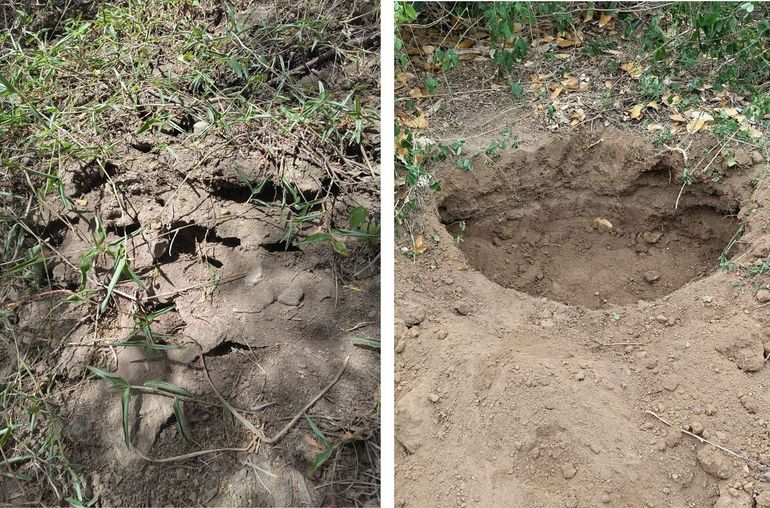
Up to 55 centimetres deep
The eggs lay at an average depth of almost 38 centimetres below ground. The shallowest nest was 25 centimetres deep and the deepest 55 centimetres. The clutches consisted of just one or two eggs. This is a small number compared to iguanas, for example, which sometimes lay several dozen eggs per clutch. Both nesting sites were in open shrub vegetation and were therefore shaded for part of the day. The lizards had dug their nests in old piles of sand left by construction work.
No eggs were found at the other sites examined. This may suggest that the lizards readily dig tunnels and burrows, but do not lay eggs everywhere. Further research is needed to establish which characteristics make a location suitable as a nesting site. This knowledge could contribute to the conservation of this species and potentially other Caribbean groundlizards.
A second life for iguana nests
The researchers discovered that Red-faced groundlizards use old nesting tunnels of the Lesser Antillean iguana (Iguana delicatissima). They found a total of five groundlizard clutches in iguana nests. Female iguanas fill their nesting tunnels with sand again after laying their eggs. These filled tunnels are easier to excavate than the surrounding compact soil. Red-faced groundlizards therefore appear to make occasional use of the earlier digging work of their larger fellow island inhabitants.
The researchers also encountered other animals in the groundlizards’ nesting tunnels, including a land crab, spiders, a cricket and a millipede. The tunnels therefore appear to provide additional space for small underground communities.
Why nest together?
“The fact that several females appear to use the same nesting site raises all sorts of questions”, says Thibaudier. “Are suitable sites scarce? Or does such a deep tunnel network offer protection against predators or extreme conditions? We also do not yet know exactly when these lizards nest or whether females produce several clutches a year. To find out, we need to monitor them for a longer period of time.” Furthermore, using the same tunnels could save energy when digging. Further research is needed to determine which factors influence whether females nest communally or individually.
Importance for conservation
The Red-faced groundlizard is classified as ‘Near Threatened’ on the IUCN Red List. On St Kitts and Nevis, populations have declined strongly because of introduced predators, such as mongooses. These do not occur on Sint Eustatius, making the island an important part of the species’ current range.
The new knowledge about nesting sites underlines the importance of underground habitats for the conservation of this lizard. This first study provides a starting point for further research into the species and other groundlizards of the genus Pholidoscelis as well.
More information
- Read the complete article A Hidden Dimension of Caribbean Reptile Ecology: First Documentation on Nesting Behavior in a Pholidoscelis Species in the scientific journal Biotropica (Association for Tropical Biology and Conservation).
Text: Julian Thibaudier, Thijs van den Burg and Cecile Leuverink, Wageningen Marine Research
Images: Pauline Raimbault (lead photo: Red-faced groundlizard (Pholidoscelis erythrocephalus)); Julian Thibaudier