

Boé in Guinea-Bissau officially recognised as a Key Biodiversity Area
Wageningen University & ResearchKey Biodiversity Areas (KBA) are sites of particular importance for the long-term survival of biodiversity, based on internationally agreed scientific criteria. The global KBA programme identifies and maps these areas, highlighting places where biodiversity is of global significance.
KBA status does not automatically give an area legal protection. However, international recognition can play an important role in decisions about land use and economic development.
Nearly twenty years of chimpanzee research
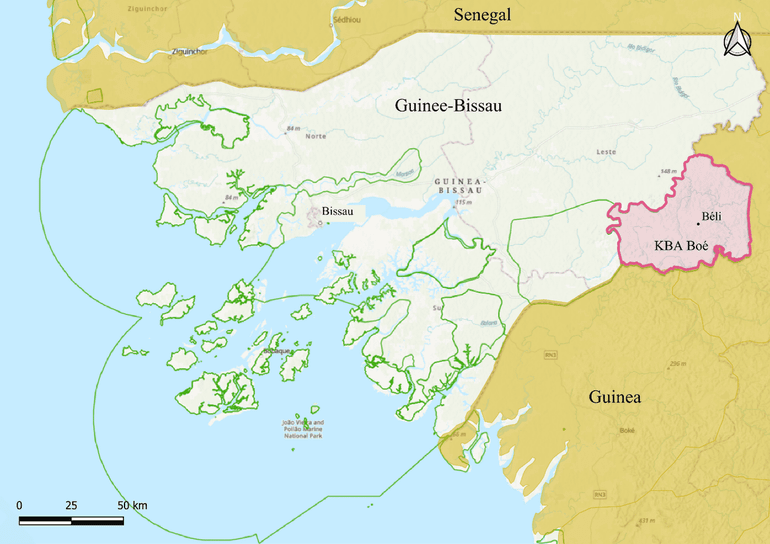
Since 2007, the Chimbo Foundation has been studying chimpanzees in the Boé region together with local communities and international partners, among which students and researchers of Wageningen University & Research. The new KBA covers around 2,460 square kilometres in south-eastern Guinea-Bissau.
Years of field research have provided extensive knowledge about chimpanzee numbers, distribution and habitat. This long-term research made it possible to assess the importance of the area against the KBA criteria.
The Boé has officially been recognised as a KBA because it is home to a significant proportion of the rapidly declining global chimpanzee (Pan troglodytes) population. Based on field surveys of chimpanzee nests and the population densities calculated from them, Binczik and colleagues estimated that between 1,465 and 4,415 chimpanzees live across the Boé. All belong to the critically endangered western chimpanzee subspecies (Pan troglodytes verus). More than five per cent of the global population of this subspecies lives in the Boé.
The Boé is the first KBA in Guinea-Bissau to be assessed and recognised under the current criteria, established in 2016. The country’s other nine KBAs were originally identified as Important Bird and Biodiversity Areas (IBAs), based on their international importance for birds. The current criteria are broader and can apply to all species groups and ecosystems.
A group of western chimpanzees (Pan troglodytes verus) captured by a camera trap in the Boé. Long-term chimpanzee research provided the scientific basis for recognition as a Key Biodiversity Area (Source: Chimbo Foundation)
Much more than chimpanzees
Although many species groups in the Boé have so far received only limited study, it is already clear that the region is home to several other threatened animal species alongside chimpanzees. Local villagers proudly report hearing lions in the area, and camera traps have confirmed the presence of both lions and leopards. The West African populations of lion (Panthera leo) and leopard (Panthera pardus) are classified as Critically Endangered (CR) and Endangered (EN), respectively.
The region is also home to three critically endangered vulture species: the hooded vulture (Necrosyrtes monachus), white-backed vulture (Gyps africanus) and Rüppell’s vulture (Gyps rueppellii). Other threatened species include the endangered Temminck’s red colobus monkey (Piliocolobus badius temminckii) and the bateleur (Terathopius ecaudatus), a species of eagle.
There are not yet sufficient population data for these species to determine whether the area also meets the KBA criteria on their behalf. The new KBA status provides an added incentive to map the region’s biodiversity more systematically.
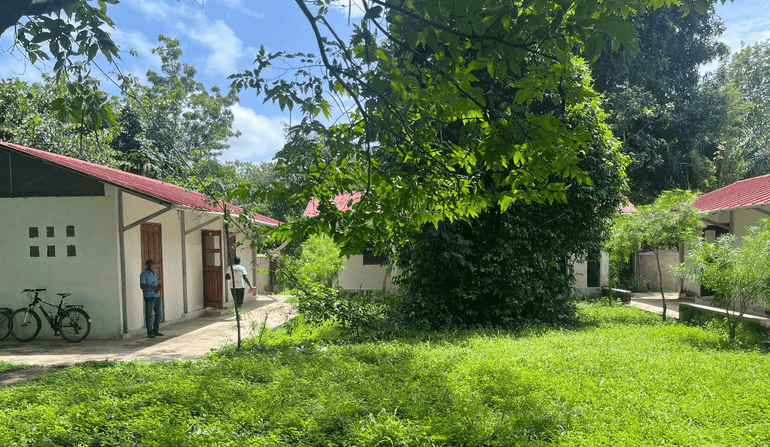
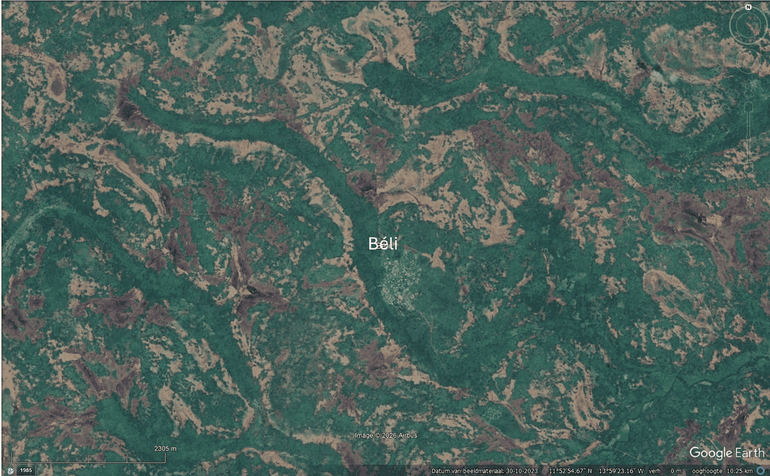
The Boé is characterised by its vast and largely unfragmented landscape. An extension of the Fouta Djallon highlands, the region consists of a mosaic of savannahs, gallery forests, dry and secondary forests, sacred forests, small agricultural fields, wetlands and rivers. Roads and other infrastructure are scarce, with only unpaved roads crossing the area. The Boé is sparsely populated, with around 60 villages scattered across the region.
Sacred forests are protected by village communities as part of traditional religious practices. They are among the best-preserved forest fragments in the landscape and are often found around water sources. In 2022, 178 sacred forests in the Boé were added to the World Database on Protected Areas (WDPA). They are registered as ICCAs: areas conserved and managed by local communities themselves.
Bauxite mining poses a growing threat
The KBA recognition comes at a crucial time. Large deposits of bauxite have long been known to lie beneath the Boé, and the prospect of mining has loomed over the region for years. Preparations by mining companies are now becoming increasingly visible, and exploratory drilling is under way.
For years, the Chimbo Foundation has advocated that any bauxite mining should be carried out as sustainably as possible, with respect for nature, culture and village communities. This is why Chimbo has been an active member of the Aluminium Stewardship Initiative (ASI) since 2016. The initiative develops international standards and certification for a responsible aluminium value chain.
Current developments, however, run counter to our efforts to promote responsible bauxite mining. Village communities are not being consulted, exploratory drilling appears to be taking place at seemingly random locations, drilling is occurring in sacred forests, and water sources are becoming polluted. These developments could be a precursor to large-scale open-pit mining, potentially affecting thousands of hectares.
This is precisely where the KBA status can make a difference. It sends a clear international signal that the Boé is not simply a remote area with bauxite deposits beneath the ground, but a landscape whose biodiversity is demonstrably of global importance. Although the KBA status does not provide legal protection against mining, it can help ensure that these natural values carry greater weight in decisions by governments, companies and financiers.
Twenty years of investing in nature and people
Protecting the Boé is about more than chimpanzees. The Chimbo Foundation takes a community-based approach, in which village communities themselves play an important role in conserving nature and also benefit from doing so. Nearly twenty years of collaboration have resulted in a wide range of initiatives, from village patrols, local firefighting teams and radio communication between villages to a local management organisation and scholarships for teenage girls.
What has been built together with the village communities is also at risk if large-scale mining fails to take sufficient account of people and nature. KBA recognition is therefore not the end of the process. It gives the Boé greater international standing and can help ensure that nature and village communities are better protected when decisions are made about the future of the region.

More information
- To learn more about chimpanzee conservation in Guinea-Bissau, visit the website of Chimbo Foundation.
Text: René Henkens, Chimbo Foundation and Wageningen University & Research
Images: Pixabay (lead photo: chimpanzee in a forest, image for illustrative purposes, this individual was not observed during the study); Chimbo Foundation