

Sharks and rays do not avoid power cables but do show behavioural changes
Wageningen Marine Research, Wageningen University & ResearchSharks and rays possess a remarkable sensory system: the ampullae of Lorenzini. These enable them to detect electrical signals, which they use, among other things, to find prey and orient themselves. Electromagnetic fields from power cables could potentially affect this sensory perception. As part of the six-year ElasmoPower research project, Annemiek Hermans, a PhD candidate at Wageningen University & Research and an employee of Witteveen+Bos, investigated how these fields could affect sharks and rays in the North Sea.
No strong avoidance
Hermans investigated both the animals’ exposure and their responses at sea and in the laboratory. For the eDNA research, she analysed 436 water samples collected over two years from four operational wind farms. DNA from five species of sharks and rays was detected in these samples. This indicates that these species are present in operational wind farms containing power cables and, at the very least, do not avoid these areas. However, eDNA cannot establish how individual animals respond to a power cable, how long they remain in its vicinity or whether they alter their swimming behaviour when they cross a cable during migration.
In a specially constructed, 15-metre-long tank, Hermans also studied the behaviour of fourteen adult small-spotted catsharks and eighteen adult thornback rays. The animals were exposed to alternating-current fields, direct-current fields and a control situation without an artificial electromagnetic field. No clear indications of attraction or avoidance were found. Nor did the animals display a startle response or a clear change in how they used the available space.
“Our results show that the electromagnetic fields around power cables do not deter sharks and rays,” says Annemiek Hermans. “They continue to occur in wind farms after construction and do not hesitate to cross a cable. What we do not yet know is what prolonged exposure means for their interactions with members of their own species and whether they are still able to find their prey.”
Changes in activity and growth
However, the electromagnetic fields were not entirely without effect. Small-spotted catsharks were active for approximately 25 percentage points less time only during exposure to a direct-current field, while their swimming speed during active movement was higher. In thornback rays, the responses differed between the sexes: females became approximately 15 percentage points more active when exposed to an alternating-current field, while males became approximately 14 percentage points less active under both alternating- and direct-current fields.
For the study of thornback ray embryos, eighteen fertilised egg cases were divided between an exposed group and a control group. The exposed embryos developed under electromagnetic fields whose strength varied daily between levels measured around a power cable at sea at different wind speeds. They displayed 33 per cent more tail movements and 150 per cent more whole-body movements. Remaining still is in fact an important response by embryos to potential danger. As no predators were present in the experiment, it cannot be determined whether the additional movement causes predators to detect them sooner. No effects were found on the duration of their development, successful hatching, their weight or their general health after hatching.
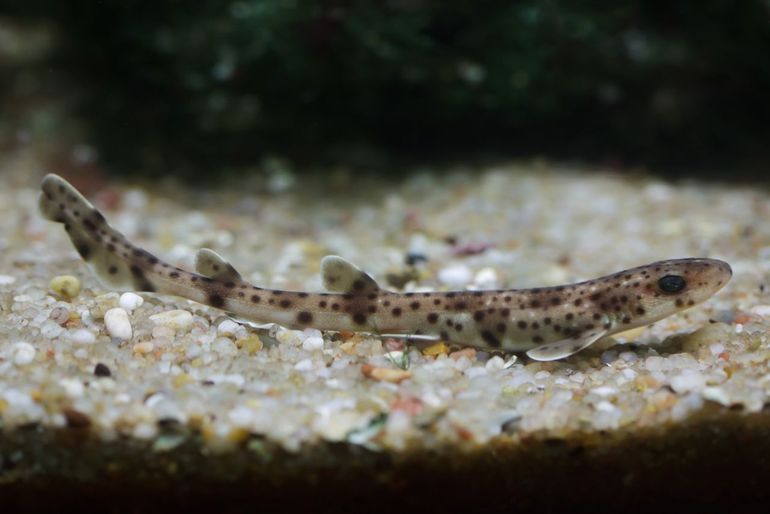
In a separate follow-up study, Hermans compared seventeen juvenile thornback rays and nineteen juvenile small-spotted catsharks that had or had not been exposed to electromagnetic fields during embryonic development. Compared with the control group, exposed juvenile thornback rays had tails that were approximately 5 per cent shorter at one and three months after hatching. In exposed juvenile small-spotted catsharks, the pectoral fins were approximately 11 per cent larger at hatching; after one month, this difference was no longer visible. The ecological significance of these differences is not yet clear.
Effects differ between species and life stages
The results for small-spotted catsharks and thornback rays cannot automatically be extrapolated to all sharks and rays. Their sensitivity may be related to factors including their life stage, mode of reproduction, habitat and migratory behaviour. Embryos of egg-laying species in particular may be exposed to electromagnetic fields for extended periods because their egg cases are located on or near the seabed during development.
Based on measurements and modelling, Hermans also shows that exposure varies considerably. The intensity and range of an electromagnetic field depend on factors including the type of cable, the amount of electricity being transported and how the cable has been installed.
Long-term effects remain unknown
The experiments provide no indications of strong acute effects on the animals studied. However, they cannot yet reveal what repeated or prolonged exposure in the natural environment means. Nor is it known whether animals become accustomed to electromagnetic fields and whether small behavioural changes ultimately affect activities such as foraging, migration, energy expenditure, reproduction or survival.
As more wind farms and interconnectors between countries are constructed, sharks and rays will encounter subsea power cables in an increasing number of locations. Further research is therefore needed into animals’ exposure and behaviour at sea, with particular attention to vulnerable species and life stages.
“Sharks and rays in the North Sea are already under pressure from various stressors, such as fishing and the degradation or loss of habitat,” says Annemiek. “Electromagnetic fields add a new, long-term pressure. Model calculations in my research indicate that, by 2030, an estimated more than five per cent of the Dutch part of the North Sea will be influenced by these fields. This alone makes it important to investigate the subtle and long-term effects further.”
Taking important habitats into account
Annemiek Hermans recommends including electromagnetic fields in environmental impact assessments and assessments of cumulative effects in the North Sea. In her thesis, she also discusses several possible precautionary measures. Where possible, cable routes could be directed around important spawning and nursery areas. Short, straight cable routes and the bundling of cables could also potentially reduce the area in which animals encounter electromagnetic fields. The effectiveness of such measures still needs to be investigated further.
About the research
The research forms part of ElasmoPower, a six-year collaborative project involving Wageningen University, Wageningen Marine Research, Naturalis Biodiversity Center, TenneT, Witteveen+Bos and the North Sea Foundation. Rijkswaterstaat is involved through the Offshore Wind Ecological Programme (Wozep).
Annemiek Hermans defends her thesis, Charged Encounters: Effects of electromagnetic fields on sharks and rays, at Wageningen University & Research on 28 August.