

New Dutch book 'Meegroeien': making room to grow with sea-level rise
NIOZ Royal Netherlands Institute for Sea ResearchThe new book ‘Ruimte voor Meegroeien met zeespiegelstijging’ (‘Making room to grow with sea-level rise’) brings together science, personal experiences, essays and artistic contributions, offering a new compass for the future. The collection is published on 30 October.
At its heart is working with the natural processes that have shaped our landscape for thousands of years. The collection was prompted by the Dutch Sea Level Rise Knowledge Programme (2019–2026). In 2025, Meegroeien (‘growing with sea-level rise’) was added to the programme as a new strategy alongside the previously developed strategies that translate as Accommodating, Protecting and Advancing seaward.
Nature and people as allies
Meegroeien gives coastal and estuarine nature an equal place in the design, alongside flood protection and freshwater availability. By restoring natural processes, nature helps build a safe delta with sufficient fresh water. At the same time, the delta’s natural environment develops once again into a rich, complex, self-regulating ecosystem.
“Sea-level rise and climate disruption are placing increasing demands on our delta, on nature and on the people who live there,” says initiator Jim van Belzen. “Meegroeien is a search for a society that once again operates within the limits of what people and nature can sustain. Flood safety is not questioned, but the approach can only succeed if it does not come at the expense of nature and people.” Van Belzen continues: “This book contains more than forty contributions from over fifty people and shows how widely Meegroeien is supported. It is not a blueprint, but a compass on the way to a rich, living delta.”
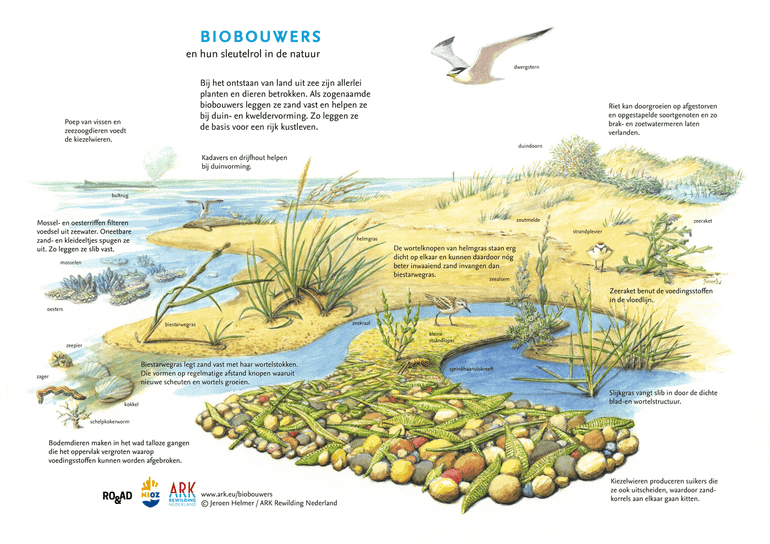
Anke Dielissen adds: “Meegroeien offers an opportunity to give our unique delta nature a real boost. Nature that does not depend on our protection, but instead protects us.”
Regional challenges
The contributions in the book show how our history has shaped the land and which insights and examples offer hope for the future, with many examples from the Rhine–Meuse–Scheldt estuary. The different views and perspectives within the region are also explored.
The Meegroeien map
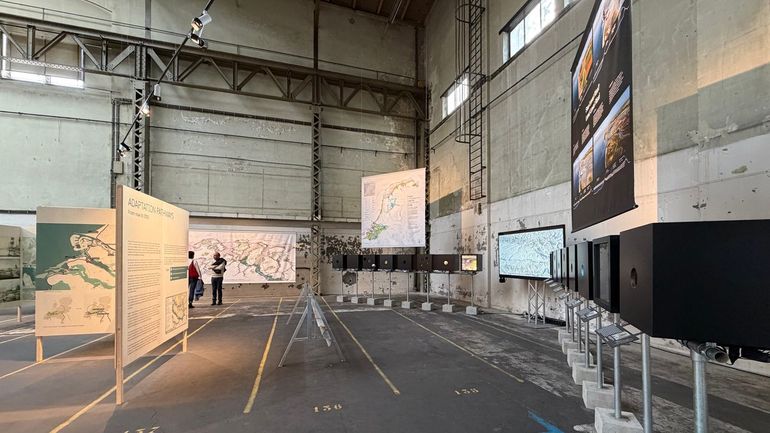
This regional challenge is illustrated particularly clearly by the accompanying ‘Doe-Je-Meegroeikaart’: a map for exploring Meegroeien together. The map depicts the Rhine–Meuse–Scheldt estuary in the very long term. Ro Koster explains: “This is a visual tool for discussing the future of this region as an estuary together, certainly not a fixed plan! The map illustrates the outcomes of a regional Meegroeien meeting exploring what might be possible if we apply Meegroeien on a broad scale. This provides a healthier basis for flood safety, food production and a good life at sea and on land.”
Koster and his fellow editors hope that the map, together with the book, will contribute to a broader conversation about the future we want to make possible for the next generations. Koster continues: “By building on natural foundations, Meegroeien offers us the best chance of a future in which the delta remains safe and liveable. Let us listen carefully, explore, experiment and discover together, because ultimately we all want the same thing: a hopeful future.”
Book exhibition and film
It is no coincidence that the book is being presented during the International Architecture Biennale Rotterdam (IABR). Its Systems of Support exhibition also explores the concept of growing with sea-level rise. Sixteen black viewing boxes offer artistic representations of different aspects or processes. There is also a film about Meegroeien and a version of the Meegroeien map measuring 6 by 2.5 metres. Together, these make the Meegroeien strategy visually accessible. The exhibition runs until 29 November.
The collection is published by NIOZ Royal Netherlands Institute for Sea Research, ARK Rewilding Nederland and the Delta Climate Centre, and was compiled by Jim van Belzen (NIOZ and WMR), Noa Hoondert and Anke Dielissen (ARK Rewilding Nederland), Ro Koster (RO&AD Architect) and Alien Kok (Zuidwestelijke Delta).
Tex: Royal Netherlands Institute for Sea Research (NIOZ), ARK Rewilding Nederland and Delta Climate Centre
Images: Jim van Belzen (lead photo: cordgrass collects silt and thus helps salt marshes to grow naturally with rising sea levels); Jeroen Helmer, ARK Rewilding; Paul Kersten