

Tiny marine animals found living inside deep-sea polymetallic nodules
NIOZ Royal Netherlands Institute for Sea ResearchPolymetallic nodules, stone-like structures from the deep sea that contain valuable metals, also turn out to be a unique habitat for a variety of small marine animals – even inside the nodules themselves. An international team of scientists reports this in a paper published in the journal Scientific Reports. Because the nodules take millions of years to form, this habitat is especially vulnerable, for example to deep-sea mining. It is therefore crucial that this discovery is considered in the environmental management of the deep sea.
The study was carried out by an international team led by Coral Diaz-Recio Lorenzo and Sabine Gollner from Royal Netherlands Institute for Sea Research (NIOZ) and Tanja Stratmann from Center for Marine Environmental Sciences at the University of Bremen, Germany (MARUM).
A tiny home in the deep sea
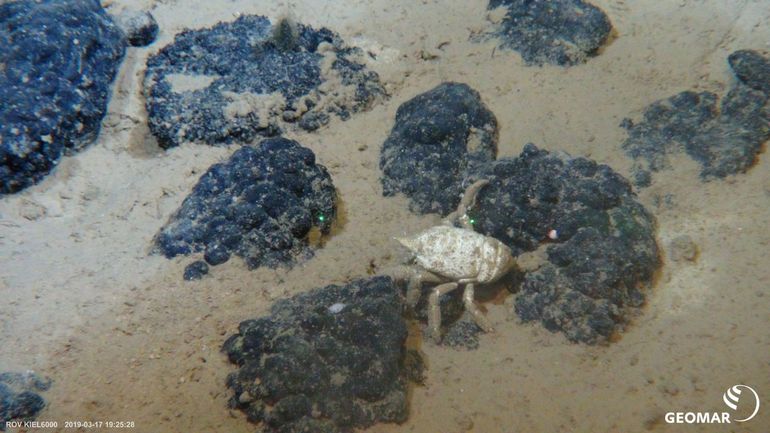
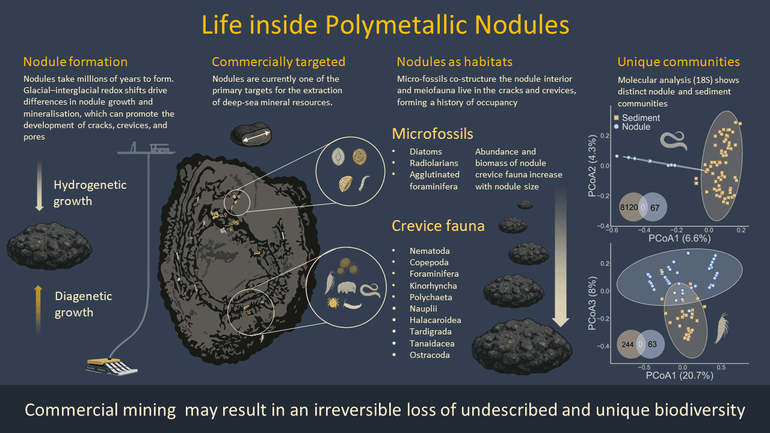
Polymetallic nodules are fist-sized, blackish-brown lumps of iron and manganese oxides that grow extremely slowly, often just a few millimetres per million years. At depths of 4,000 to 6,000 metres, they form hard surfaces on an otherwise soft, muddy seafloor. It was already known that organisms live on the outside of these nodules. Now, the researchers took a closer look at the organisms living in the small crevices and cavities. Inside, they discovered a distinct community of species that clearly differs from the one in the surrounding seafloor.
The team collected samples in the Clarion-Clipperton Zone in the central Pacific Ocean, using remotely operated vehicles (ROVs), among other tools. Back in the laboratory, the researchers carefully took the nodules apart to collect the inhabitants of the crevices. "It turns out that the sizes of cracks inside the nodules are large enough to provide home to animals that are smaller than a millimetre in size”, says Stratmann. Thanks to their internal structure, the nodules not only offer living space on their outer surface but also form a three-dimensional habitat.
A distinct community spread across a thousand kilometres
In the 244 nodules examined, the scientists found a total of 4,139 animals, an average of about 17 per nodule. The most densely populated nodule contained 245 animals.
Fewer animals live inside the nodules than in the surrounding seafloor. For nematodes (roundworms), numbers are about 10 per cent of those in the sediment; for copepods, about 25 per cent. Even so, their presence matters for the entire ecosystem, mainly because of differences in species composition. Genetic analyses showed that the communities inside the nodules were very similar to one another, even across distances of up to 1,000 kilometres, but clearly differed from those in the sediment. “The crevices in the polymetallic nodules function as small shelters and provide a home for animals that we do not encounter in the soft sediment of the seafloor”, says Diaz-Recio Lorenzo (NIOZ, now Roscoff Biological Research Station).
Risks associated with deep-sea mining
These findings have significant societal implications. Polymetallic nodules are a target for industrial deep-sea mining because of the metals they contain, such as nickel, cobalt, and copper. Since the nodules take millions of years to grow, removing them would result in a loss of this unique habitat and all associated life.
One example is the single-celled species Thurammina sp. 1, which is particularly common in the nodules. This species appears to be perfectly adapted to the sheltered spaces within the nodules. If the nodules were removed through mining, these specialized inhabitants would lose their habitat and might have nowhere else to go. “Our findings point out that commercial mining may result in an irreversible loss of undescribed and unique biodiversity associated with nodules”, says Gollner. “This needs to be considered in the environmental management of deep-sea mining.”
This new knowledge underscores that protecting the deep sea means taking into account not only large animals but also microscopic inhabitants. Future research should determine whether the loss of these local communities could lead to the extinction of certain species, or whether these animals can also survive elsewhere. This knowledge is essential for designating protected areas and assessing the environmental impacts of deep-sea mining projects.
More information
Text: Royal Netherlands Institute for Sea Research (NIOZ)
Images: NIOZ/Sensu (lead photo: polymetallic nodule is analysed in the lab); GEOMAR; Coral Diaz-Recio Lorenzo